

How Robin Sloan is using printing to critique this current tech moment
The novelist and “creative industrialist” on manufacturing, AI, and how he's using printing to show another way forward.
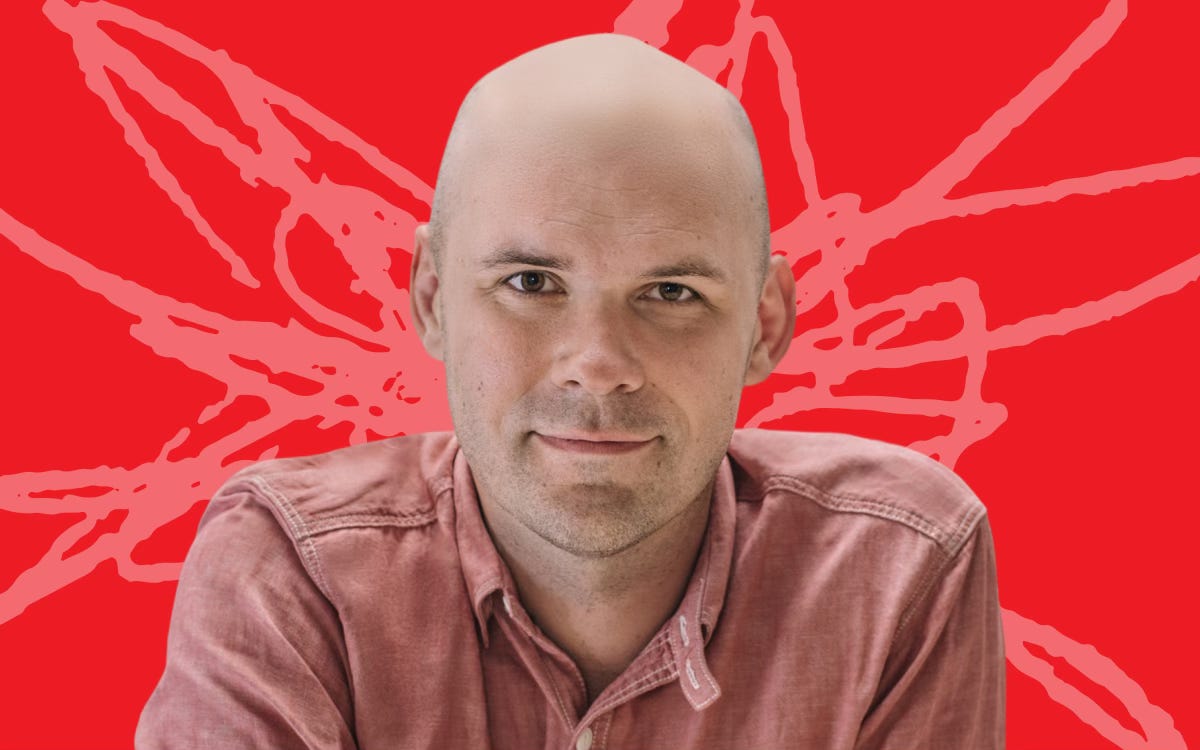
Robin Sloan (episode 90) is known, primarily, as a novelist. His first novel, Mr. Penumbra’s 24-Hour Bookstore, was released in 2012 and was a New York Times Best Seller (and still one of my favorite books!). He’s since followed that book with two more novels, 2017’s Sourdough, and 2024’s Moonbound, the latter of which is the first book in a proposed series. Alongside this writing, however, Robin has been increasingly experimenting with printing. Each bottle of Fat Gold Olive Oil, the olive oil he produces with his partner Kathryn Tomajan, comes with a Risograph-printed zine and last year he wrote and printed a series of zines that felt like celebrations of the Post Office and critiques of the digital environment we now find ourselves in.
His latest project, is perhaps his most ambitious. The Penumbra Print Shop, where he is manufacturing stationery and other printed matter that also invents new forms and interactions between print and computer technology. The first product is a “magic postcard” that allows the sender to “attach” a piece of digital media to it, accessible through a QR code. In one way, this is a very Robin Sloan project — experimental, provocative, craft-focused — but it also feels like a shift in his work, a sly critique of the digital tools Robin has been involved with since their beginnings.
I’ve been curious about these experiments in printing and the larger thesis of this body of work so I caught up with Robin over Zoom to talk through it all. We talk about his early term “media inventor” and how that has evolved, the influence of producing olive oil on his interest in printing, and how a book about the history of notebooks, truly, changed his life. Our call has been edited for clarity.

I don’t know if you remember our podcast episode, but we talked a lot about the term “media inventor” which is how you described yourself on your website at the time. It’s a term I’ve come to really appreciate and have used in my own work. When I was prepping for this, your site said: “Robin Sloan: writer, printer, manufacturer” and then I looked at it today and it’s changed again, to “creative industrialist.” Talk me through that evolution from media inventor to printer and manufacturer to creative industrialist.
Oh, I love that! That’s great. That’s actually a really fun timeline. To go back even a step further, there was a day when I didn’t say “writer” anywhere on the internet, because I was just doing other work, working at media companies, more of an office worker. I can still remember, vividly, the day I changed my Twitter bio to say “writer,” which felt quite risky and presumptuous and momentous. Naturally, no one cared or noticed. At that point I don’t even think I’d published any fiction online, so it was entirely aspirational.
But I do think all of those relabels, for me, have been leading indicators rather than trailing ones. It’s the point at which I realize what I want to be doing, what kind of worker I want to be, and I put it up there. I reload my website every day and look at it. It’s for me, to remind me of what I’m trying to do.
“Media inventor” is funny to think about now. One reason I downplayed it is that it was my own invented term, and it was confusing people as much as it was clarifying anything. But at the time I was thinking strictly about storytelling: new ways to present fiction, games, things adjacent to cinema, comic books, all that kind of stuff.
What’s changed is that, honestly, Jarrett, I read a book and it changed my life. The book was The Notebook by Roland Allen.
That’s been on my list since it came out!
It’s fabulous. It’s a great, crisp, readable, deep history of the notebook as an object in human history that starts before paper. In the opening chapters he’s telling you about merchants traveling with little wax tablets, writing down their olive oil orders. And I was like, oh good, it’s all one story. What’s interesting about the notebook, and the reason it connects to media invention, is that he’s talking about objects that are useful and open to other people’s uses. My mode, for so long, unapologetically and unrepentantly, was imposing myself and my ideas and visions and stories on other people in the world.
Then the experience of the olive oil played into this too. The idea that you’re supporting other people’s health and livelihood and happiness, that they can cook whatever they want with it. Reading that book and then thinking about it for months afterward really did change my idea of what kinds of inventions I might consider. That’s where printing came from, and also manufacturing. I was like, that’s right, I want to be making things, not just publishing things.
When I think about “media inventor,” especially in relation to your work, I’ve always thought of it as something digital, something screen-based. That seems like it’s changed too.
I think that’s correct, and it might be me as part of a larger story, a band of people who set out down this path in, call it 2005, and then got to the end and said, oh wait, this is incomplete. We understand it so much better now, and it’s just not interesting enough to keep cranking out web pages of increasingly dazzling sophistication with wonky new interfaces. Even just saying that, I’m like, that doesn’t sound fun anymore.
The other thing I was thinking about as you were talking is the shift from inventor to industrialist. There’s a sense of infrastructure, of a business, more people involved. Inventor sounds solitary. Industrialist sounds like something bigger. Does that mean anything to you?
Maybe I should have been thinking more carefully about the “media inventor” label, because the truth is I have felt more like an inventor in the last year than I ever did in the 2010s. Experimenting with things, iterating on possibilities, sketching things out, giving them to other people to try. Maybe the physical part of this work is what unlocked that. I think I’m earning the inventor label more now than the Robin who first called himself an inventor ever did. Isn’t that funny?
Tell me more about how the olive oil has influenced all of this work. Some of your early print experiments felt like celebrations of physical infrastructure: of the post office, of the whole supply chain. That’s harder to perceive when things are only digital. But it becomes visible when something goes through the mail. That feels like something you learn in the olive grove.